Mostrar mensagens com a etiqueta artigos. Mostrar todas as mensagens

quinta-feira, 3 de outubro de 2013

Notícia: Naufrágio de navio com imigrantes faz pelo menos 93 mortos em Itália


"O mar está cheio de corpos", afirmou a presidente da câmara de Lampedusa, Giusi Nicolini. "É horrível, é como um cemitério, continuam a trazê-los", disse aos repórteres.

Pelo menos 93 imigrantes, entre os quais três dezenas de crianças, morreram no naufrágio de um navio que transportava quase 500 pessoas e se incendiou, na madrugada desta quinta-feira, perto de Lampedusa, na Sicília, Sul de Itália.


Os números de vítimas estão a subir de hora a hora. Pouco antes de o Corriere della Sera ter actualizado o número de corpos recolhidos para 93, tinham sido anunciados 82 mortos. E antes disso 50.

"Há 250 desaparecidos", disse, a meio da manhã, fonte das entidades envolvidas nos socorros, citada pela edição digital do diário La Repubblica.

Ler a notícia completa em Público.


A lamentar, a divulgar, a reflectir.  A Europa continua silenciosa perante a tragédia que decorre no mar que lhe banha os "pés".


sexta-feira, 8 de março de 2013

Artigo: Expresso-pt - "Quero que todo o Mundo saiba a nossa situação"

Por Giorgos Kosmopoulos, da equipa de campanhas da UE da Amnistia Internacional e Carmen Dupont, Coordenadora da campanha europeia sobre migração


«Em dezembro passado, 27 pessoas (maioritariamente afegãs), que tentavam chegar à Grécia, morreram afogadas perto da costa de Lesvos após o barco em que viajavam se ter virado. Apenas sobreviveu um rapaz de 16 anos. Os nossos pensamentos voltaram às visitas que fizemos nos dias anteriores, em Atenas, a um dos muitos centros de detenção e a algumas casas que albergam pessoas que fugiram ao conflito na Síria. Bahrir, Ralya e Alia tinham chegado à Grécia, numa outra noite, em circunstâncias semelhantes.
Conhecemos Ralya, uma rapariga de dez anos, no primeiro dia da nossa visita a Atenas. Ela andava descalça pelo chão frio de uma casa abandonada onde mais ninguém quereria viver. A sua família paga todos os meses 165 euros de renda. Eles fugiram da Síria por causa do conflito. Vive com o pai e os irmãos enquanto a mãe está na Alemanha.
"O barco de plástico que nos transportava pelo rio Ebro afundou e ficámos separados da minha mulher", explicou o pai.
Brahim, um dos filhos, tem 15 anos. Contou-nos que gosta de jogar futebol e marca muitos golos pela sua equipa. Um dia, Brahim chegou a casa a sangrar. Tinha sido atacado por um grupo de jovens vestidos de preto. Lembra-se de ouvir um deles a gritar "batam-lhe, batam-lhe".»


quarta-feira, 1 de fevereiro de 2012

Notícias: UNHCR News Story: More than 1,500 drown or go missing trying to cross the Mediterranean in 2011


More than 1,500 drown or go missing trying to cross the Mediterranean in 2011

«GENEVA, January 31 (UNHCR) – The UN refugee agency on Tuesday released figures showing that more than 1,500 irregular migrants or refugees drowned or went missing last year while attempting crossings of the Mediterranean Sea.

"This makes 2011 the deadliest year for this region since UNHCR started to record these statistics in 2006. The previous high was in 2007 when 630 people were reported dead or missing," Senior Communications Officer Sybella Wilkes told journalists in Geneva, while adding that at least 18 people had drowned this year to date after setting off from Libya for Europe.

"Our teams in Greece, Italy, Libya and Malta, warn that the actual number of deaths at sea may be even higher," Wilkes said. "Our estimates are based on interviews with people who reached Europe on boats, telephone calls and e-mails from relatives, as well as reports from Libya and Tunisia from survivors whose boats either sank or were in distress in the early stages of the journey," she explained.

Wilkes also revealed that a record 58,000 irregular migrants, asylum-seekers and refugees managed to make it to European shores last year after setting off in boats from Asia or North Africa. The previous high was in 2008, when 54,000 people reached Greece, Italy and Malta.

During 2009 and 2010, border control measures sharply reduced the number of arrivals in Europe. The frequency of boat arrivals increased in early 2011 as the governments in Tunisia and Libya collapsed.

The majority of last year's arrivals by sea landed in Italy (56,000, of whom 28,000 were Tunisian) while Malta and Greece received 1,574 and 1,030 respectively. The majority arrived in the first half of the year and most were migrants, not asylum-seekers or refugees. Only three smuggler's boats arrived after mid-August.

UNHCR's Wilkes said that so far this year, "despite high seas and poor weather conditions," three boats had attempted the perilous journey from Libya and one of them – carrying 55 people – had gone missing.

"Libyan coastguards informed UNHCR that 15 dead bodies, all identified as Somali, were found washed up on the beaches [of Libya] last week, including 12 women, two men and a baby girl. On Sunday, three more bodies were recovered," Wilkes said. It was later confirmed that all those who drowned were Somali residents of the makeshift site in Tripoli known as the Railway Project.

The other two boats made it to Malta and Italy, but required rescuing. The Italian coastguard saved 72 Somalis, including a pregnant woman and 29 children, on January 13. The second boat was rescued two days later by the Maltese armed forces with the support of the US navy and a commercial vessel. In total 68 people were rescued from a drifting dinghy.

"UNHCR welcomes the ongoing efforts of the Italian, Maltese and Libyan authorities to rescue boats in distress in the Mediterranean. We renew our call to all shipmasters in the Mediterranean . . . to remain vigilant and to carry out their duty of rescuing vessels in distress," Wilkes said.»


quarta-feira, 9 de novembro de 2011

Artigo e Foto.: PACE - Images of life for ‘boat people’ from North Africa

The tiny Italian island of Lampedusa has been the destination for many refugees, asylum-seekers and migrants fleeing the conflicts in North Africa in recent months. In May 2011 a five-strong PACE delegation visited the island to hear at first hand from some of the “boat people” who have made the perilous journey across the Mediterranean and see for themselves the conditions they faced...


Fotografias e legendas aqui: Council of Europe Parliamentary Assembly

segunda-feira, 7 de novembro de 2011

Artigo: NY Times - After Liberation, Nowhere to Run

IN late March, as Libya’s civil war raged, loyalist soldiers forced Abu Kurke, a 23-year-old political refugee from Ethiopia, onto an inflatable boat with dozens of other African migrants and dispatched them from Tripoli’s port into the unforgiving waters of the Mediterranean.

The journey almost killed Mr. Kurke. After leaking oil, the boat went adrift between Tripoli and the Italian island of Lampedusa. A helicopter spotted it, and soldiers threw down a few bottles of water and gestured that help would come.

Hours became days. Stranded at sea, the boat encountered bad weather. Waves beat against the vessel, knocking two people overboard. Food and water soon ran out, and exhausted passengers began to die of starvation and thirst. The Italian Coast Guard was alerted and reportedly made contact with a warship in the area. Still, no help came. 

segunda-feira, 31 de outubro de 2011

Artigo - ACNUR: Mixed Migration into Europe

Mixed migration into Europe
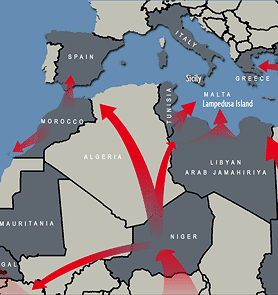
They cross from West Africa to the Spanish Canary Islands; from Morocco to southern Spain; from Libya to Malta and the Italian islands of Sicily and Lampedusa; and from Turkey to the islands of Greece  


«Taking their chances on fishing boats, dinghies and canoes, every year thousands of men, women and children drown in a desperate bid to reach Europe from Africa. Many more enter the European Union by land, via Turkey and the Balkans or from Ukraine and Belarus.

People entering Europe irregularly - without passports or visas - do so for a variety of reasons. In some cases they are fleeing persecution, human rights violations and armed conflict and can, therefore, be considered as refugees who need special protection. More often, they are migrants trying to escape poverty and unemployment.

In order to help governments respond to some of the challenges posed by mixed movements of refugees and migrants in a coherent and practical way, the UN refugee agency has started implementing a 10-point plan which sets out key areas in which action is required in countries of origin, transit and destination.»

quinta-feira, 27 de outubro de 2011

siciliamigranti: reportagem de Lampedusa - Os últimos barcos...

«Sono arrivata sabato a Lampedusa. E’ giornata di sbarchi. 7 dalle 10 alle 22. Un totale di circa 600 persone, che aggiunte alle 500 circa già presenti nei due centri fanno 1100 persone rinchiuse, in attesa di identificazione e trasferimento nei CIE o di rimpatrio. Domenica si è verificato un ulteriore sbarco alle 4 del mattino e uno di 36 persone a Linosa. Si tratta in questi ultimi sbarchi esclusivamente di tunisini. Poche donne e minori.»

Ler o restante aqui:
siciliamigranti: Report Lampedusa 10-12 ottobre 2011

Reportagem de
Alice Pugliese
Para
Il Forum Antirazzista di Palermo

segunda-feira, 24 de outubro de 2011

Artigos: Revolt in Lampedusa: CIE in flames « clandestina

CIE of Lampedusa set on fire by the Tunisians: “No deportations”


«The elderly lock themselves in the house, the kids put a handkerchief to their mouth while the column of smoke blown by the mistral invades. Smell of plastic, scrap metal, burnt rubber. “A toxic cloud – dare someone – who knows how much crap we are breathing.” The sky turns from blue to gray, the airport closes, the police are unleashed to to look for hundreds of escaped Tunisians. And Lampedusa falls again in the worst of nightmares, with two of the three warehouses in the centre of the district Imbriacola incinerated by the fire lit by a group of migrants exasperated by confinement and deportation. The anger, the fear of invasion, the memories of the old fire in February 2009 come back. Mayor Dino De Rubeis abandon all restraint and talks about war: “There is a population that cannot bear any longer, that wants to take to the streets with batons – he says – who should protect us has not done so. What we expected , unheeded by the national government, has happened, with 1,500 immigrants who have proved to be people of ill repute. ” The deputy mayor Angela Maraventano, senator of the Northern League, shoots even bigger, “Tunis should compensate us and welcome them in the country’s prisons.”»

Ler o restante aqui:
Revolt in Lampedusa: CIE in flames « clandestina